PART 4
I barely slept that night.
After putting Lily and Sophie to bed, I sat at my kitchen table with the attorney’s letter in front of me, replaying everything that had happened at Daniel’s wedding.
For thirteen years, I had believed that keeping our family together was my greatest responsibility. I had sacrificed my comfort, postponed my dreams, and convinced myself that love meant being patient even when I was hurting.
When Daniel left, I thought I had failed.
Now I was beginning to understand that the end of our marriage might not have been my greatest loss.
It might have been the beginning of my freedom.
The following morning, I met Laura, the attorney who had contacted Michael. She reviewed the documents with me and explained that the property records needed to be verified before anyone could reach a conclusion.
The house had been purchased during our marriage. My name appeared on some of the original paperwork, but later records showed changes that required further investigation.
There were also unexplained financial transfers and inconsistencies between Daniel’s statements during the divorce and the documents now available.
“Rebecca,” Laura told me, “I don’t want to promise you an outcome before we finish reviewing everything. But you have every reason to ask questions and protect your rights.”
For the first time, someone wasn’t telling me to be quiet, accept less, or move on.
Someone was telling me that my questions mattered.
Over the next several weeks, Laura helped me gather my old financial records, tax documents, and copies of our divorce agreement. We requested the appropriate records and began the process of determining whether Daniel had failed to disclose assets or misrepresented our financial position.
It wasn’t glamorous.
There were no dramatic courtroom speeches or overnight victories.
There were appointments, paperwork, difficult memories, and days when I wondered whether I had the strength to keep going.
But every time I felt discouraged, I remembered Daniel laughing at me in front of his wedding guests.
And I remembered something even more important: Lily watching me with worried eyes, asking whether I was going to cry.
I wanted my daughters to grow up knowing that being kind didn’t mean accepting cruelty.
So I kept going.
Then, six weeks after the wedding, Laura called.
“Rebecca, we’ve completed an important part of the review. There are substantial discrepancies between the financial information Daniel provided during the divorce and the records we’ve obtained.”
I closed my eyes.
“What does that mean?”
“It means we have grounds to pursue the matter further. We still need to establish exactly what happened and what remedies are available, but you’re not imagining the inconsistencies.”
I sat down slowly.
For months, Daniel had made me feel as though I was unreasonable for questioning him.
Now, at last, the facts were being examined independently.
The legal process continued for several months. Daniel disputed the findings, and his representatives challenged parts of the evidence. Nothing was settled simply because he had been confronted at his wedding.
But the more the records were examined, the harder it became to explain the discrepancies.
Eventually, Daniel agreed to a financial settlement after further review and negotiation. The agreement addressed the disputed assets and provided for an appropriate division of the property interests established during the process.
I didn’t receive a magical fortune.
I didn’t become rich overnight.
But I received something I had been denied for far too long: a fair opportunity to recover what the evidence showed I was entitled to.
And with that came something even more valuable.
I could finally stop wondering whether I had imagined the way he treated me.
I hadn’t.
Meanwhile, Daniel’s new marriage was facing problems of its own.
Vanessa contacted me one afternoon.
When I saw her name on my phone, I almost ignored the call.
I didn’t owe her a conversation. She had known Daniel was married when their relationship began, and I wasn’t interested in becoming her confidante.
But something made me answer.
“Rebecca,” she said quietly, “I know you probably don’t want to hear from me.”
I waited.
“I wanted to apologize.”
I didn’t respond immediately.
She continued.
“After the wedding, I asked Daniel to explain everything. He told me you were trying to destroy our marriage because you were jealous. He said Michael had manipulated you and that the documents were taken out of context.”
“That sounds familiar,” I replied.
She sighed.
“I believed him at first. I wanted to believe him. But then I started remembering things he’d told me about our future. Some of the things he promised me didn’t make sense anymore.”
I leaned against the kitchen counter.
“Vanessa, I’m sorry you’re hurting. But I can’t make your decisions for you.”
“I know.”
Her voice trembled.
“I thought I was marrying a man who had made a difficult decision to leave an unhappy marriage. I didn’t understand how much of the story I had been given was incomplete.”
I thought about the woman I had been a year earlier, desperately trying to understand why my husband had stopped loving me.
Part of me wanted to tell Vanessa that she should have known better.
Another part understood that Daniel had been telling different versions of the same story to different people for years.
“I hope you figure out what you need to do,” I told her. “But whatever happens between you and Daniel, I need to focus on my children and myself.”
She thanked me.
We ended the call.
I didn’t forgive her that afternoon, and I didn’t need to.
Forgiveness wasn’t a debt I owed anyone.
I could move forward without carrying hatred, while still keeping my distance from the people who had hurt me.
That was enough.
Daniel tried to contact me several times after the settlement discussions began.
At first, his messages were angry.
Then they became defensive.
Finally, they became strangely sentimental.
He reminded me of our early years together, when we were young and full of dreams. He mentioned our first apartment, our wedding photographs, and the summer we took Lily to the beach for the first time.
He wrote that he had made mistakes.
He said he had been under pressure.
He suggested that we had both contributed to the breakdown of our marriage.
I read his messages carefully.
There had been difficult times in our marriage. I wasn’t perfect, and neither was he.
But acknowledging that a relationship had problems was not the same as accepting responsibility for someone else’s choices.
I eventually agreed to meet him in a public café to discuss arrangements concerning the girls.
He arrived looking tired.
For the first time since our divorce, he didn’t seem certain that he controlled the conversation.
“Rebecca,” he began, “I know things have gone too far.”
I stirred my coffee.
“What do you want to discuss?”
He looked frustrated by my question.
“I want us to stop fighting.”
“Then let’s keep our conversations focused on the girls and the arrangements we need to make.”
He leaned forward.
“You know, I never expected you to turn into this person.”
I looked at him.
“What person?”
“Someone who fights back over everything.”
I almost laughed.
For years, he had made decisions that affected my life, then accused me of being difficult whenever I questioned them.
“I haven’t turned into someone else, Daniel,” I said. “I’m simply no longer afraid to disagree with you.”
He looked down at the table.
For a moment, I saw something that resembled regret.
“I didn’t think you’d manage without me.”
The honesty of the statement surprised me.
I studied his face.
“That’s the problem, Daniel. You thought my life depended on you. You thought that if you stopped choosing me, nobody else would. You thought that if you told me I wasn’t attractive enough, smart enough, or successful enough, I’d spend the rest of my life trying to prove you wrong.”
He didn’t answer.
“But I don’t need to prove anything to you anymore.”
He swallowed.
“Do you hate me?”
I considered the question.
There had been a time when I had imagined telling him how much I hated him. I had rehearsed speeches in my head while washing dishes, driving to work, and lying awake at night.
But sitting across from him, I realized I didn’t want to spend any more of my life organizing my emotions around him.
“No,” I said. “I don’t hate you. But I don’t trust you, and I don’t want you back.”
His eyes lifted to mine.
“Not even for the girls?”
I shook my head.
“Our daughters deserve parents who treat each other respectfully. They don’t need us to pretend we’re in love. They need us to be responsible adults.”
He sat silently for a long time.
Then he nodded.
We finished discussing the practical arrangements and left separately.
Outside, the afternoon sunlight felt warmer than I expected.
I had spent so long hoping Daniel would finally understand my worth that I hadn’t realized how exhausting it was to keep waiting for his approval.
That day, I stopped waiting.
Michael remained beside me throughout those difficult months.
He never pressured me to call him my boyfriend for real. He never treated the fact that he had helped me as something I owed him for.
Sometimes he brought dinner when I was overwhelmed. Sometimes he helped me carry groceries upstairs while Sophie insisted on showing him every drawing she had made that week.
He learned that Lily liked astronomy books and that Sophie refused to eat vegetables unless they were arranged into funny shapes.
He listened when I needed to talk, but he never demanded that I discuss the past when I wasn’t ready.
One evening, after the girls had gone to bed, we sat on my balcony.
“Can I ask you something?” I said.
“Of course.”
“Why did you help me so much?”
He thought for a moment.
“Because you deserved help.”
I smiled faintly.
“That’s all?”
He turned toward me.
“Rebecca, when we first started working together, I noticed something about you. You were always the person helping everyone else. If someone had a problem, you tried to solve it. If someone needed support, you made time for them. But whenever you were struggling, you acted as though asking for help would make you a burden.”
I looked down at my hands.
“I suppose I got used to it.”
“I know.”
He paused.
“But I didn’t help you because I wanted you to owe me anything. And I didn’t come to that wedding to win a competition with Daniel.”
“Then why did you come?”
He smiled gently.
“Because you asked me to stand beside you. And I thought you deserved to have someone there who would.”
His words settled over me quietly.
I had spent so much time thinking about whether a man would ever want me that I had forgotten to ask myself a more important question.
What kind of person did I want beside me?
Someone who admired my appearance?
Someone who needed me to make him feel powerful?
Or someone who could respect me even when I was tired, uncertain, and still putting the pieces of my life back together?
I didn’t answer Michael that night.
I wasn’t ready.
But for the first time, the possibility of love didn’t frighten me.
It felt like something I could choose when I was ready, rather than something I had to chase before I became too old or too imperfect to deserve it.
Almost a year after Daniel’s wedding, I took Lily and Sophie back to the beach where we had spent one of our happiest family holidays.
The girls ran toward the water, laughing as the waves rushed around their feet.
I watched them from a blanket on the sand.
Lily had grown taller. Sophie had become more talkative, asking a hundred questions every day and insisting that she could already read almost any word she saw.
I thought about the woman who had stood at Daniel’s wedding, embarrassed and uncertain, wondering whether the entire room believed his cruel words.
I wished I could go back and tell her something.
You are not the worst thing someone has ever said about you.
You are not the years you spent sacrificing for another person.
You are not the number on a scale, the wrinkles around your eyes, or the opinion of a man who stopped appreciating you.
You are still here.
And you are allowed to begin again.
“Mummy!” Lily called. “Come into the water with us!”
I laughed.
“It’s freezing!”
“That’s what you always say!”
Sophie came running toward me, her little arms waving.
“Come on, Mummy!”
I stood up, kicked off my sandals, and ran toward them.
The water was cold enough to make me gasp, and the girls shrieked with laughter when I splashed them.
For several minutes, I forgot about lawyers, bank records, divorce agreements, and wedding gifts.
I was simply a mother playing with her children.
A woman enjoying a beautiful afternoon.
A person whose life still held possibilities she hadn’t yet imagined.
Later, while we sat together eating sandwiches, my phone buzzed.
It was a message from Michael.
Hope you’re having a wonderful day. Save me a seat at dinner tonight?
I smiled and typed back.
Only if you bring dessert.
His reply arrived almost immediately.
Deal.
I looked out at the ocean.
Daniel had once told me that nobody would ever want me.
But the truth was that I had never needed an audience to establish my worth.
I had needed time to remember it myself.
And if love eventually found me again, I wanted it to find a woman who wasn’t looking for someone to rescue her.
I wanted it to find a woman who knew she could stand on her own, but was willing to make room for someone who treated her well.
That evening, when Michael joined us for dinner, he brought a small box of pastries for the girls.
Sophie immediately claimed the largest one.
Lily rolled her eyes and laughed.
Michael looked at me across the table.
“You seem happy,” he said.
I thought about it.
“I am.”
“Good.”
He didn’t ask for anything more.
And that was when I realized I was beginning to fall for him—not because he had embarrassed Daniel, not because he had brought a mysterious box to a wedding, and not because he had helped me recover what was rightfully mine.
I was falling for him because he never made me feel that I had to earn basic kindness.
Our relationship grew slowly, with honest conversations, shared meals, and quiet moments that meant more than grand declarations.
Eventually, I agreed to a real date.
Not a pretend boyfriend arrangement.
Not a performance designed to make my ex jealous.
Just two people choosing to spend time together.
And whether our future lasted a lifetime or simply brought us more happiness for a season, I knew I would never again confuse being loved with being controlled.
As for Daniel, his life continued without me.
His marriage faced its own challenges, and he had to deal with the consequences of the financial questions that had surfaced. Whatever happened between him and Vanessa was theirs to resolve.
I stopped asking mutual acquaintances for updates.
I stopped checking his social media.
I stopped measuring my progress against his.
My daughters still had a father, and I encouraged them to maintain a healthy relationship with him wherever it was safe and appropriate. I refused to make them responsible for the pain between their parents.
They deserved a childhood, not a courtroom.
And I deserved a future that wasn’t permanently tied to my past.
Two years after that wedding, Lily asked me a question while we were preparing dinner.
“Mummy, do you remember when Daddy said nobody would ever want you?”
My hands stopped moving.
Children have a way of bringing the past into the room when you least expect it.
“Yes, sweetheart,” I answered carefully.
“Did it make you sad?”
I turned off the stove and knelt beside her.
“Yes. It made me very sad.”
She looked thoughtful.
“Why did you believe him?”
The question struck deeper than she could have understood.
I brushed a strand of hair away from her face.
“Because sometimes, when someone we love says something hurtful, we think they must know something about us that we don’t know ourselves.”
She frowned.
“But he was wrong.”
I smiled gently.
“Yes, he was.”
Lily wrapped her arms around me.
“Then you should never believe anyone who says something like that to me.”
I held her tightly.
“That’s right. And I hope you remember something else, too. You don’t have to prove you’re worthy of love by being beautiful, successful, or perfect. You deserve respect because you’re a person. Anyone who truly loves you should never make you feel that you must become someone else to earn it.”
She nodded, then returned to setting the table.
I watched her for a moment, feeling tears gather in my eyes.
Perhaps that was the greatest gift I could give my daughters.
Not a perfect family.
Not a life without heartbreak.
But the knowledge that they could walk away from cruelty without believing it defined them.
And the confidence to build a life where kindness wasn’t something they had to beg for.
I had once walked into Daniel’s wedding hoping to prove that I was still desirable.
I left that chapter of my life understanding something far more important.
My worth had never depended on whether Daniel wanted me.
His laughter hadn’t made me less valuable.
His betrayal hadn’t made me less deserving of love.
And his decision to leave hadn’t taken away my right to build a beautiful life.
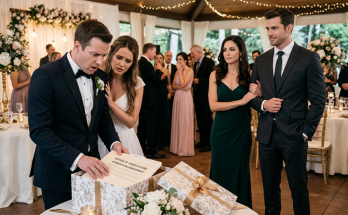
The box Michael brought to that wedding contained documents, photographs, and questions that helped me begin a difficult process of seeking justice.
But the most important thing I carried away from that day wasn’t inside the box.
It was the realization that I no longer needed to stand in front of Daniel and convince him that I mattered.
I already knew.
And this time, I wasn’t going to let anyone make me forget.

One Comment on “My Ex-Husband Mocked Me at His Wedding,”