“Then tell them the truth.”
She looked offended.
“You don’t understand how difficult you’re making this.”
I stared at her.
“Bryn, you submitted financial information involving my money without my permission. I am not responsible for the consequences of that decision.”
She sat down heavily.
“Do you have any idea how much pressure we’ve been under?”
I didn’t answer.
She continued.
“Dylan lost his job. My real estate business has been terrible. We’ve been trying to get back on our feet. We can’t keep living like this.”
“I understand that you’ve had difficulties.”
“Then why can’t you help us?”
“I already did.”
She looked at me.
I continued quietly.
“I opened my home to you. I gave you a bedroom. I asked for only $400 toward household expenses. I didn’t ask you to pay rent at the market rate. I didn’t demand that you furnish the room or contribute to the mortgage because there is no mortgage.”
Bryn shook her head.
“That’s not enough.”
Her words hung in the air.
And suddenly, I understood.
She hadn’t viewed my offer as help.
She had viewed it as the beginning of an opportunity.
An opportunity to become comfortable in a house she thought might eventually belong to her.
I stood up.
“Then perhaps you need to find somewhere else to live.”
She looked at me sharply.
“Are you kicking us out?”
“No. I’m telling you that this arrangement may no longer be working. We will follow the written agreement and all applicable legal requirements. But I will not allow this situation to continue indefinitely.”
She opened her mouth.
Then she closed it.
For once, she had nothing to say.
Two days later, I received another call from Patricia.
She had spoken with the lender’s investigation department.
They had confirmed that the document was being reviewed because the purported financial contribution had not been independently verified.
They also wanted to know whether I had provided any bank statements or financial records.
I told them I hadn’t.
Then Patricia asked me something unexpected.
“Peg, have you ever given Bryn access to your computer?”
I thought about it.
Several months earlier, when my printer had stopped working, Bryn had offered to help me connect it to the wireless network.
She had used my desktop computer for a few minutes.
I remembered leaving the room to answer the door.
I told Patricia.
She became quiet.
“Do you still have the computer?”
“Yes.”
“Don’t alter anything. We should preserve what is available and let the appropriate professionals review it.”
I followed her advice.
I also changed my email password, secured my online accounts, and contacted my financial institutions.
I didn’t accuse Bryn of accessing anything.
I didn’t know what had happened.
But I wasn’t going to take another chance with my personal information.
The following week, something else happened.
Dylan came into my bedroom carrying a small wooden box.
It was Frank’s old box.
The one he had kept in his study for years.
I looked at it.
“Where did you find that?”
“In the back of the closet.”
He placed it on the bed.
“I thought you might want to see what’s inside.”
I opened the lid.
Inside were several old photographs, a pocket watch, and a folded letter.
The letter was addressed to Dylan.
I recognized Frank’s handwriting immediately.
My throat tightened.
“Your father wrote this shortly before he died,” I said.
Dylan sat beside me.
“I didn’t know it was here.”
I unfolded the paper carefully.
The letter was dated four months before Frank passed away.
It read:
My dear Dylan,
If you’re reading this, I hope you’re doing well and building a life that makes you proud.
Your mother has always been stronger than she realizes. She has spent much of her life looking after other people, and I hope you never mistake her kindness for an inability to stand up for herself.
One day, you may need her help. If that day comes, accept it with gratitude, but never make her feel that she owes you her peace.
This house is more than bricks and wood. It is where your childhood happened, where your mother and I built our marriage, and where we hoped you would always feel welcome.
But remember something important: a home is not an inheritance that begins while its owner is still alive.
Your mother deserves to enjoy every year she has left here without feeling like a guest in her own life.
Love,
Dad.
I stopped reading.
The paper trembled slightly in my hands.
Dylan was crying.
I placed the letter on the bed.
For a long time, neither of us spoke.
Finally, he whispered, “I forgot how much Dad understood.”
I looked at him.
“Your father understood people because he listened to them.”
Dylan nodded.
Then he said something I had been waiting weeks to hear.
“I’m sorry, Mom.”
I looked into his eyes.
“For what?”
“For letting Bryn treat you like this. For not defending you when she wanted your bedroom. For allowing her to make decisions about your house. And for thinking about what I could get instead of what you were giving.”
I swallowed.
“Dylan, I don’t need you to agree with everything I say. You’re an adult. You’re allowed to have your own opinions.”
He nodded.
“But I need you to remember that I’m your mother, not an obstacle standing between you and something you want.”
He began crying harder.
“I know.”
I put my hand over his.
“I hope you do.”
The next morning, Bryn received a formal letter from Patricia.
It explained that the ninety-day occupancy arrangement remained subject to its written terms and applicable law.
It also clearly stated that:
-
No renovations were authorized.
-
No one had permission to advertise, list, sell, or negotiate the sale of the property on my behalf.
-
No one could represent that I had agreed to provide money for a purchase.
-
Any further use of my personal financial information required my express authorization.
The letter was professional and straightforward.
There were no insults.
No threats.
Just facts.
Bryn read it twice.
Then she came downstairs.
“You hired an attorney against us?”
I looked up from my newspaper.
“I hired an attorney to protect my interests.”
“Against your own son?”
“Against actions that I did not authorize.”
She threw the letter onto the table.
“You’re making us look like criminals.”
“I haven’t called you criminals. I have asked questions and reported an unauthorized financial representation involving my name.”
She stared at me.
“You know what? Maybe we should just leave.”
I folded my newspaper.
“If that’s what you decide, we’ll arrange the move according to the agreement and the law.”
She looked surprised.
Perhaps she had expected me to beg her to stay.
But I didn’t.
For the next several hours, the house remained quiet.
Then, around five o’clock, I heard Bryn calling someone.
She was arranging to view an apartment.
Three weeks later, the lender informed me that its review was complete enough to establish that my alleged financial contribution had not been verified.
The application could not proceed on the basis of the claimed $95,000 gift.
I was also informed that the lender had referred the questionable signature for further review.
I gave them everything they requested through the proper channels.
Patricia advised me not to speculate about the outcome or confront Bryn with accusations beyond what we could establish.
So I didn’t.
I focused on my own life.
I went back to the farmers market.
I started attending my Wednesday book club again.
I had Carol over for lunch.
And I began sleeping peacefully in my own bedroom.
It was surprising how much better I felt once I stopped listening for furniture being dragged across the hallway.
But there was still one important conversation I needed to have.
On a Sunday evening, Dylan came downstairs and asked whether we could sit together.
Bryn was upstairs packing some boxes.
He sat opposite me at the dining table.
“Mom, Bryn and I found an apartment.”
I put down my tea.
“Where?”
“Beavercreek. It’s smaller than our old place, but we can afford it.”
“When are you moving?”
“Next Saturday.”
I nodded.
“Have you read the agreement about the move-out arrangements?”
“Yes. Patricia explained what we needed to do.”
“Good.”
He looked around the dining room.
“I didn’t think things would end this way.”
“Neither did I.”
He looked down.
“Are you going to forgive me?”
I took a moment before answering.
“Dylan, forgiveness isn’t something I can give you just because you’re moving out. It takes time.”
He nodded.
“I understand.”
“But you’re my son. I love you. I always will.”
His eyes filled again.
I reached across the table.
“What I need from you now is honesty. If you need help, ask. If you make a mistake, admit it. And if someone is treating me unfairly, don’t stand silently because it’s easier than getting involved.”
He held my hand.
“I promise.”
I wanted to believe him.
This time, I decided I would judge him by what he did next.
Saturday morning arrived.
By nine o’clock, a moving truck was parked in my driveway.
Dylan carried boxes downstairs while Bryn supervised the movers.
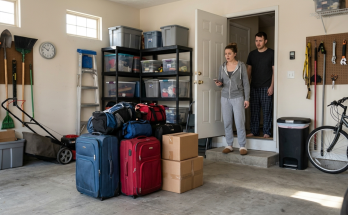
There were suitcases, clothing racks, lamps, kitchen appliances, and several boxes filled with things they had purchased during their stay.
I stood in the doorway watching.
Bryn walked past me carrying a large handbag.
She stopped.
“Peg, I hope you’re happy now.”
I looked at her.
“I’m happy to have my home back.”
She shook her head.
“You could have made this much easier.”
I didn’t argue.
Dylan came over carrying the final box.
“Mom, I’ll call you tomorrow.”
“Drive safely.”
He hugged me.
For a moment, I held him tightly.
He was still my son.
Then he stepped away.
Bryn gave me a brief nod.
Neither of us said goodbye.
At 11:35, the moving truck pulled away.
I stood in the driveway until it disappeared around the corner.
Then I went inside.
The house was silent.
Not the uncomfortable silence I’d experienced while they were living here.
It was peaceful.
I walked upstairs.
The back bedroom was empty.
I entered my own bedroom and looked at Frank’s reading glasses on the nightstand.
His shirts were still hanging in the closet.
My grandmother’s quilt was still folded across the foot of the bed.
I sat down.
And for the first time in months, I cried.
Not because I’d lost my son.
But because I had finally understood how much it hurts when someone you love makes you feel like you no longer belong in your own home.
Six weeks passed.
Dylan called occasionally.
At first, our conversations were short.
He asked about the weather, the garden, and whether I had received the Christmas cards I ordered.
Then, slowly, he began talking about work.
He had found a position with a logistics company in Dayton.
It wasn’t his old job, and the salary was lower, but he seemed relieved to have a steady income again.
Bryn returned to working in real estate.
Their apartment was modest, and they were learning to manage their expenses without relying on me.
One afternoon, Dylan called and asked whether he could visit.
“Of course,” I said.
He arrived the following Sunday carrying a small box.
Inside was a beautiful wooden restoration kit and a handwritten note.
“What’s this?” I asked.
He smiled.
“I remembered the cedar chest.”
I looked at him.
He continued.
“I know the furniture repair was already paid for, but I wanted to do something to show you I haven’t forgotten.”
I opened the box.
There was also an envelope.
Inside was a check for $180.
The exact amount of the restoration estimate.
“Dylan, you already paid me for that.”
“I know. This isn’t about the money. I just wanted to acknowledge what happened.”
I looked at him for a long moment.
Then I placed the check back inside the envelope.
“Thank you.”
He glanced around the living room.
“It’s nice to see everything back where it belongs.”
I smiled slightly.
“Yes, it is.”
He sat down.
After a few minutes, he said, “Mom, I need to tell you something.”
I looked at him.
“What is it?”
“Bryn and I have been having problems.”
I didn’t interrupt.
He continued.
“She thinks you turned me against her. She says I should have supported her plans because we were trying to build a future.”
I folded my hands.
“And what do you think?”
He looked toward the window.
“I think I spent too much time trying to keep everyone happy. I didn’t realize that by avoiding conflict with her, I was hurting you.”
I nodded.
“That’s something you need to work through together.”
“I know.”
He paused.
“I’m not asking you to take sides.”
“Good.”
He smiled sadly.
“I just wanted you to know that I understand things differently now.”
I reached across the table and touched his hand.
“That’s a good place to start.”
The following spring, something wonderful happened.
I decided to repaint the kitchen.
Not because it needed renovation.
Not because someone had promised an audience a new design.
I simply wanted a fresh color.
I chose a soft cream shade for the walls and replaced two old light fixtures.
I kept Frank’s maple cabinets.
I kept the granite countertops.
And I kept the little breakfast nook exactly as it was.
When the work was finished, Carol came over with a homemade apple pie.
She stood in the doorway and looked around.
“Peg, it looks beautiful.”
I smiled.
“Thank you.”
She glanced at the breakfast nook.
“Are you keeping Frank’s old chair?”
I looked at the wooden chair beside the window.
“Of course.”
I had considered replacing it.
But I couldn’t bring myself to do it.
Every morning, I still sat there with my coffee and watched the birds gathering around the feeders.
Sometimes, I imagined Frank sitting across from me.
Sometimes, I talked to him.
And sometimes, I simply enjoyed the quiet.
Nearly a year after Dylan and Bryn moved out, I received an unexpected letter.
It was from Bryn.
I almost put it aside.
But something made me open it.
Inside was a handwritten note.
Peg,
I know we didn’t part on good terms. I’ve had a lot of time to think about what happened while Dylan and I were living with you.
I was under a lot of pressure. I was worried about money, my career, and our future. But that doesn’t excuse how I treated you.
I should never have tried to take your bedroom. I shouldn’t have used your furniture, your kitchen, or your personal information without permission.
I also understand that I made assumptions about your house and your future that were never mine to make.
I’m sorry for making you feel unwelcome in your own home.
I don’t expect you to forget what happened or forgive me immediately. I just wanted to acknowledge that I was wrong.
Bryn.
I read the letter twice.
Then I placed it inside the drawer of my desk.
I didn’t call her.
I didn’t send a long response.
But I appreciated that she had finally acknowledged what she had done.
A month later, she and Dylan invited me to dinner at their apartment.
I accepted.
The apartment was small but clean.
Bryn had prepared chicken, vegetables, and a homemade dessert.
She had even bought a small bouquet of yellow flowers for the table.
At one point, she approached me while Dylan was in the kitchen.
“Peg, I want to say something.”
I looked at her.
“Go ahead.”
“I know I damaged our relationship.”
I remained quiet.
She continued.
“I don’t expect everything to go back to normal. But I’d like to try to build something better, if you’re willing.”
I looked at her face.
For the first time, she wasn’t trying to convince me that I was wrong.
She wasn’t making excuses.
She was simply asking.
“Bryn, I appreciate your apology. But rebuilding trust takes time.”
She nodded.
“I understand.”
I smiled gently.
“Then let’s start with being respectful to one another.”
She returned my smile.
And that was enough for that evening.
Two years later, my life looked very different.
I was still living in my brick colonial in Kettering.
The maple tree Frank planted was taller than ever.
The bird feeders were full.
The cedar chest had been restored.
And my wedding china remained safely behind the little brass lock in the dining room cabinet.
Dylan visited regularly.
He and Bryn were doing better financially, although they still lived in their apartment.
They eventually began saving for a home of their own.
One Sunday, Dylan arrived with a small framed photograph.
It was a picture of Frank and me standing in front of the house in 1994.
We were young.
Frank had one arm around my shoulder, and I was holding a small bouquet of flowers.
The house behind us looked almost exactly as it did today.
Dylan placed the photograph on the mantel.
“I thought you might like this downstairs.”
I looked at it.
Then I looked at him.
“Thank you.”
He smiled.
“Dad would be happy to see you still taking care of the place.”
I touched the edge of the frame.
“I think he’d be happy to see you growing up, too.”
Dylan laughed.
“I hope so.”
That afternoon, we sat together in the kitchen.
He drank coffee at the breakfast nook.
I sat in Frank’s old chair.
And for the first time in a very long time, I felt that my son and I were finding our way back to each other.
Not because I had surrendered my boundaries.
Not because I had given him the house.
But because he had finally learned that loving someone meant respecting them.
That evening, after Dylan left, I walked upstairs and opened my bedroom door.
The sunlight was fading through the curtains.
I looked at the bed, the cedar chest, and the quilt my grandmother had made.
I remembered the morning Bryn stood in that room with her iced coffee and told me I could sleep in the den.
I remembered Dylan telling me not to make things weird.
I remembered the suitcases lined up in the garage.
And I remembered the moment I realized that I had spent too much of my life worrying about disappointing people who had no problem disappointing me.
I walked over to the cedar chest and gently ran my hand across its polished surface.
Then I sat on my bed.
I was sixty-eight years old.
I had been a wife, a mother, a court reporter, a widow, and now a woman learning to put herself first.
I had discovered something important.
Being generous doesn’t mean giving people permission to take everything.
Being a mother doesn’t mean sacrificing your dignity.
And being alone doesn’t mean you have to surrender control of your life to keep someone beside you.
I looked toward Frank’s reading glasses on the nightstand.
“I’m still here, Frank,” I whispered.
Then I smiled.
And I knew exactly what he would have said.
Good. It’s your house. Enjoy it.
I turned off the bedside lamp and settled beneath my grandmother’s quilt.
For the first time in a long time, there was no one rearranging my furniture, moving my belongings, or deciding where I belonged.
I was home.
And I had never been more certain of it.


One Comment on “My Daughter-in-Law Demanded My”