PART 3
I stepped aside.
“Of course. It’s cold out there.”
Carter walked in first. Yvette followed, brushing past me without saying thank you.
I closed the door and led them into the living room.
My late husband, Arthur, had built the bookshelves along the far wall himself. His favorite novels still occupied the bottom shelf, and a framed photograph of him holding our newborn son sat beside the fireplace.
Carter glanced at the photograph as he passed.
For a moment, his expression softened.
Then his phone vibrated, and whatever memory had crossed his mind disappeared.
Yvette remained standing.
“Well?” she demanded. “What exactly are you trying to prove?”
I placed the document on the coffee table.
“Nothing. I’m simply making sure everyone understands what I will and won’t be paying for this Christmas.”
She picked it up.
At the top was a list of the original arrangements.
The chalet.
The ski passes.
The private dinner.
The groceries I had planned to order before our arrival.
The children’s winter activities.
Even the additional transportation I had arranged so nobody would have to drive through the mountains in bad weather.
Every item had its price beside it.
At the bottom, I had written the total.
Then I had added a second column showing what I had changed.
Yvette scanned the page, her lips tightening with every line.
“You actually wrote all this down?”
“I did.”
“Why?”
“Because apparently, we have different understandings of what it means to give someone a Christmas gift.”
She dropped the paper onto the table.
“This is about the video, isn’t it?”
“Yes.”
“You’re punishing us because my mother received some presents?”
“No, Yvette. I’m adjusting my spending because I realized I had been planning to spend thousands of dollars on people who apparently consider me an obligation.”
Carter finally spoke.
“Mom, that’s not fair.”
I turned toward him.
“Which part?”
He opened his mouth, then closed it again.
“Which part isn’t fair, Carter? The part where I paid for the vacation? The part where your wife told me you couldn’t afford a Christmas present? Or the part where I discovered you had spent thousands of dollars on her mother two days later?”
He rubbed his forehead.
“It wasn’t supposed to happen like this.”
I felt something tighten in my chest.
“Then how was it supposed to happen?”
He looked at Yvette.
She folded her arms.
“Carter bought those things for my mother because she has done so much for us. She helped us when we were struggling. She has always been there.”
I nodded slowly.
“I’m glad she has.”
Yvette seemed to expect an argument, because my agreement left her visibly unsettled.
“She deserves to be appreciated,” she continued.
“I agree.”
“And this is her first Christmas since she retired. We wanted to make it special.”
“That sounds lovely.”
“Then why are you acting like we’ve done something wrong?”
I looked at her for several seconds.
“Because you told me you couldn’t afford a gift for me, not because you couldn’t afford a gift for your mother. Those are two very different things.”
Yvette’s cheeks reddened.
“You don’t understand our relationship.”
“Perhaps not. But I understand mine with my son.”
I turned to Carter.
“When your father was alive, he used to say that you could learn a great deal about a person’s priorities by watching what they did when they thought nobody was keeping score.”
I gave a small, sad smile.
“I’m beginning to understand what he meant.”
Carter looked toward the window.
For a moment, I thought he might apologize.
Instead, he said, “We were counting on this trip.”
There it was.
Not I’m sorry.
Not I understand why you’re hurt.
Not even I should have handled this differently.
They were counting on the trip.
I leaned back in my chair.
“I know.”
“The kids have been talking about it for weeks,” he continued. “They’ve already told their friends. They were excited about skiing and the chalet.”
“And I want them to have a wonderful Christmas.”
“Then why change everything?”
“Because I can love my grandchildren without agreeing to finance every expectation their parents develop.”
Yvette made a disbelieving sound.
“Oh, please. Nobody is asking you to finance our entire lives.”
I looked at her.
“No? Then let’s talk about the last four Christmases.”
She fell silent.
I reached for the folder beside me.
“Four years ago, I paid for the family’s Christmas dinner at the restaurant you chose. The year after that, I rented a cottage because you said the children needed a holiday away from the city. Last year, I covered the hotel rooms when you decided everyone should spend Christmas in Quebec City.”
I paused.
“And this year, I rented a six-bedroom chalet because you told me the children had always dreamed of spending Christmas in the mountains.”
Carter shifted uncomfortably.
“I never asked you to do all that, Mom.”
I looked at him with genuine surprise.
“You didn’t?”
He shook his head.
“No. You offered.”
“Yes,” I replied. “I did.”
I let the words settle between us.
“That is precisely why I’m allowed to change my mind.”
For a few seconds, nobody spoke.
Outside, a car moved slowly along the icy road. The branches of the bare maple tree beside my driveway trembled in the wind.
I had always loved winter in this part of Quebec. Even after Arthur died, I found comfort in the quiet of the season.
But that morning, my living room felt unfamiliar.
Perhaps because I was finally seeing the people in it without the excuses I had spent years making for them.
Yvette picked up the document again.
“So what? You’re just going to abandon us?”
“No.”
“That’s exactly what you’re doing.”
“I’m going on the vacation I paid for. Cordelia is coming with me. The children are welcome to spend time with their grandmother, provided their parents can arrange their own travel and accommodations. But I am no longer paying for the additional expenses I originally agreed to cover.”
“You’ve removed our ski passes!”
“Yes.”
“The dinner reservation!”
“Yes.”
“And you’ve downgraded the chalet!”
“I changed the reservation to a smaller property that I can comfortably afford without feeling resentful.”
She stared at me.
“Resentful?”
“Yes, Yvette. Resentful.”
I rarely used that word.
For most of my life, I had considered resentment a personal failure. If I felt unappreciated, I told myself I should communicate better. If someone took advantage of my generosity, I told myself I should give without expecting anything in return.
Arthur had often warned me about that habit.
“Rosalind,” he used to say, “being kind doesn’t mean you have to make yourself invisible.”
I had laughed whenever he said it.
Now, sitting across from my son and daughter-in-law, I wished I had listened sooner.
Yvette turned to Carter.
“Are you going to let her do this?”
He looked at me.
“Mom, can we at least keep the original chalet? We can pay you back later.”
I studied his face.
“Can you afford it?”
He hesitated.
“We’ll work something out.”
“That wasn’t my question.”
He glanced toward Yvette again.
She was staring at him, waiting for him to give the answer she wanted.
Finally, he said, “Not right now.”
“Then how would you pay me back?”
“I don’t know. Over time.”
“How much could you afford each month?”
His silence answered for him.
I nodded.
“That’s what I thought.”
Yvette suddenly laughed, but there was no humor in it.
“This is unbelievable. You have plenty of money, Rosalind. Why are you acting as if this is some financial crisis?”
I looked at her carefully.
“My financial situation is not the point.”
“Of course it is. You can afford it.”
“And because I can afford something, I must buy it for you?”
She opened her mouth.
Nothing came out.
I continued.
“Your mother received beautiful presents. I’m happy for her. I hope she enjoys every one of them. But I am not obligated to compete with her, and I am not obligated to purchase affection from my own family.”
Carter flinched.
“Mom, nobody thinks you have to buy our affection.”
I held his gaze.
“Then why are you standing in my living room arguing with me about a vacation I paid for?”
That silenced him.
Yvette grabbed her handbag.
“This conversation is going nowhere.”
“You’re welcome to leave whenever you like.”
She stared at me as though she could not believe I had said it.
Then she turned toward the door.
Carter remained seated for another moment.
“Mom,” he said quietly, “I don’t want Christmas to be ruined.”
Neither did I.
That was the heartbreaking part.
I had not spent weeks planning the chalet because I wanted to impress anyone. I had done it because Arthur was gone, and I had been trying to keep something alive that he and I had built over decades.
A family tradition.
A place where our children could return, where grandchildren could make memories, where the empty chair beside me might feel a little less empty.
I wanted Christmas to be a reminder that we still belonged to one another.
But somewhere along the way, my generosity had become an expectation.
And expectations, when left unchallenged, can begin to look remarkably like entitlement.
“I don’t want Christmas ruined either,” I told him. “But I can’t keep pretending that everything is fine just because confronting it makes everyone uncomfortable.”
Carter stood.
“I’ll talk to Yvette.”
“I hope you do.”
He walked toward the door, then stopped.
“Can I ask you something?”
“Of course.”
“Did Dad ever think we were taking advantage of you?”
The question caught me off guard.
I looked at the photograph on the bookshelf.
“Your father loved you more than anything in the world. He wanted you to have a good life. But he also believed that love should make people more considerate, not less.”
Carter swallowed.
“Did he say that about me?”
“No,” I answered honestly. “He said it about all of us.”
I saw the relief in his face, followed by something that looked almost like shame.
Then he left.
Yvette was already sitting in the passenger seat, staring at her phone.
I watched their car disappear down the road.
For several minutes, I stood by the window.
Then I returned to the kitchen, poured myself another cup of tea, and called my daughter.
Cordelia answered on the third ring.
“Mom? Is everything okay?”
I laughed softly.
“Why wouldn’t it be?”
“Because Carter just sent me a message saying you changed the Christmas plans, and Yvette is apparently furious.”
I closed my eyes.
“Ah.”
“What happened?”
I told her everything.
The message.
The Instagram video.
The chalet.
The confrontation.
When I finished, Cordelia remained quiet for so long that I checked whether the call had disconnected.
“Cordelia?”
“I’m here.”
“Well?”
She exhaled sharply.
“Mom, I love my brother. You know I do. But this has been happening for years.”
I sat down.
“What do you mean?”
“I mean, you always make excuses for him. When he forgets your birthday, he’s busy. When they cancel dinner, the kids have activities. When you pay for something, it’s because you’re generous. When they don’t do anything for you, you tell everyone they have a lot on their plates.”
Her voice softened.
“But when do you get to be the person who has something on her plate?”
I didn’t answer.
Because I didn’t know.
Cordelia continued.
“Remember last Christmas, when you spent the whole morning preparing dinner and Yvette complained that the table decorations didn’t match her photographs?”
I remembered.
I had laughed it off.
“And remember when you bought the grandchildren those winter coats, and Carter said you should have checked with Yvette first because she preferred a different brand?”
I remembered that, too.
“And what about your birthday? You invited them to dinner, and they canceled at the last minute because Yvette’s mother wanted to go to a spa.”
I pressed my fingers against my forehead.
“I didn’t think you noticed all that.”
“Of course I noticed. I just didn’t want to interfere with your relationship with Carter.”
I felt a sudden sting behind my eyes.
“I never wanted you to feel as though I loved him more than you.”
“Mom, that’s not what I’m saying.”
“Because sometimes I worry—”
“Stop.”
Her voice was gentle but firm.
“You don’t have to defend yourself to me. I know you love us both. That’s why this hurts so much. You keep giving because you want the family to stay close, but I think you’ve started believing that if you stop giving, everyone will stop coming.”
I stared at my untouched tea.
The worst part was that she hadn’t accused me of anything I could easily deny.
I had never consciously believed my family would abandon me if I stopped paying for things.
But I had noticed how quickly plans changed when I wasn’t the one arranging them.
How often invitations arrived after I had offered to host.
How frequently my phone rang when someone needed a favor, a loan, childcare, or help with a bill.
And how quiet it became when I simply wanted company.
Cordelia sighed.
“I’m sorry, Mom. I should have said something sooner.”
“No,” I whispered. “You shouldn’t have had to.”
We stayed on the phone for nearly an hour.
By the time we hung up, I felt something I hadn’t felt in a long time.
Not happiness.
Not exactly.
But clarity.
And clarity, I was beginning to learn, could be a kind of freedom.
The next morning, I went into town to finish my Christmas shopping.
The streets were crowded, the shop windows filled with lights and artificial snow. Parents hurried past with strollers, children dragged their boots through slush, and people carried bags filled with gifts they hoped would make someone else happy.
I bought a scarf for Cordelia.
A puzzle for my youngest grandson.
A set of watercolor pencils for my granddaughter, who had recently announced that she wanted to become an artist.
For Carter, I bought nothing.
Not because I wanted to punish him.
Because for the first time, I wasn’t going to force myself to do something simply because I was afraid of how it would look if I didn’t.
On my way home, I stopped at the grocery store and picked up ingredients for a small Christmas dinner.
Turkey.
Potatoes.
Carrots.
Cranberries.
Everything I needed to make the meal Arthur had loved.
At the checkout, I saw a woman struggling to keep her toddler from pulling a chocolate display onto the floor.
She looked exhausted.
I smiled at her.
“Christmas shopping?”
She laughed.
“More like Christmas survival.”
We shared a brief conversation about the weather, our families, and how quickly children grew up.
When I left, I realized I had enjoyed talking to a complete stranger more than I had enjoyed several recent family gatherings.
That thought followed me all the way home.
I had spent so much time trying to create the perfect holiday for everyone else that I had forgotten Christmas could be simple.
A warm kitchen.
A good meal.
A few people who genuinely wanted to be there.
And the freedom to enjoy the day without wondering whether anyone was keeping a list of what I owed them.
That evening, I began making a new plan.
A smaller chalet.
A simpler dinner.
No elaborate schedule.
No expensive activities designed to impress anyone.
Just a quiet Christmas with Cordelia, the grandchildren, and perhaps a few friends who had become family over the years.
I was halfway through writing a grocery list when my phone rang.
It was Yvette’s mother, Denise.
I almost didn’t answer.
Denise had always been pleasant to me in person. We had exchanged polite greetings at birthdays and family gatherings, but we weren’t close.
I couldn’t imagine why she would be calling.
“Hello, Denise.”
“Rosalind! Thank goodness you answered.”
Her voice sounded unusually bright.
“I was just speaking with Yvette, and she told me there has been some confusion about Christmas.”
I set down my pen.
“Has she?”
“Yes. Apparently, the accommodation arrangements have changed. I wanted to make sure everything was still going ahead because the children are so excited.”
I took a breath.
“The holiday is still going ahead. The accommodation is simply smaller, and the arrangements have changed to reflect what I’m comfortable paying for.”
“Oh.”
There was a pause.
Then she laughed lightly.
“Well, these things happen. I’m sure Carter can sort it out.”
I said nothing.
Denise continued.
“Actually, I was wondering whether you might have room for one more person at the chalet. Yvette mentioned that there could be some extra space, and I thought it might be lovely to join everyone for Christmas.”
For a moment, I thought I had misunderstood.
“You want to come to the chalet?”
“If that’s all right, of course. I don’t want to impose.”
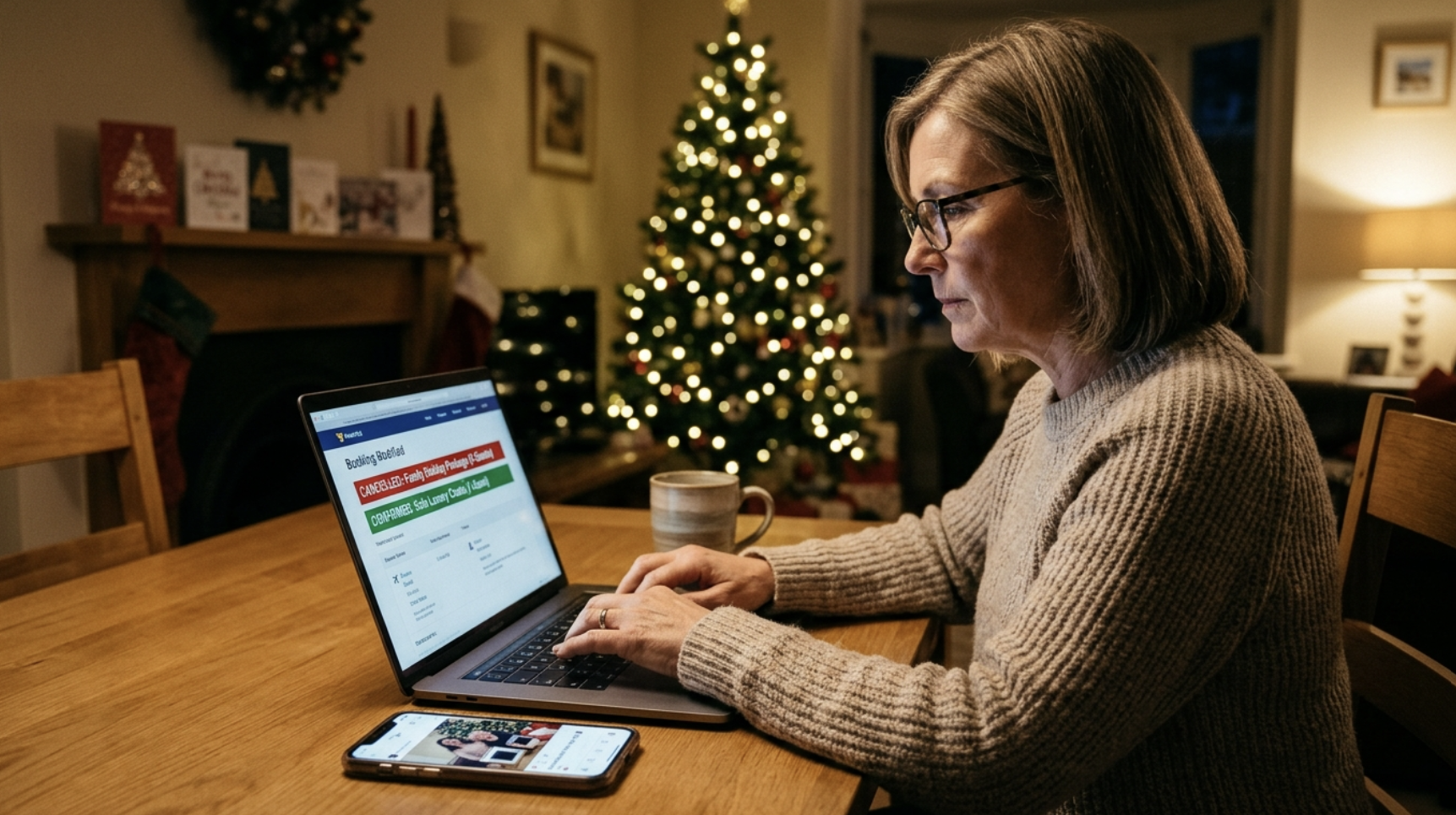
I looked at the new reservation on my laptop.
The smaller chalet had three bedrooms.
Cordelia and I would share the main living space with the grandchildren, who were staying only for part of the trip. There was no extra bedroom for Denise, and I had already canceled the additional dinner seats.
“I’m afraid that won’t be possible this year,” I said.
“Oh. I see.”
Her cheerful tone faltered.
“Perhaps we could make other arrangements? Yvette said you had booked a very large property originally.”
“I did. But I’ve changed it.”
“Yes, she mentioned that. She seemed rather upset.”
“I imagine she was.”
Another pause followed.
Then Denise said something that made me sit very still.
“I do hope this isn’t because of those presents Carter bought me.”
I stared at the phone.
“What makes you ask that?”
“Well, Yvette told me there was a disagreement about them.”
I felt a strange mixture of sadness and disbelief.
“So she told you about the gifts.”
“Of course. She sent me the video herself. I was so surprised by everything. I told her it was far too much.”
I leaned back in my chair.
“Did you know she had told me that they couldn’t afford to buy me a Christmas present?”
Silence.
This time, it was long enough that I could hear the faint hum of traffic through Denise’s phone.
“No,” she finally said. “I had no idea.”
I believed her.
There was something in her voice that sounded genuinely uncomfortable.
“Carter and Yvette are adults,” I said. “They can spend their money however they choose. I have no right to dictate that. But I also have the right to decide how I spend mine.”
“Of course.”
“I don’t want a gift from them if it comes with resentment. I don’t need expensive electronics or anything else. I simply don’t want to be treated as though I’m less worthy of consideration than everyone else.”
“Oh, Rosalind.”
Her voice softened.
“I am so sorry.”
I swallowed.
“Thank you.”
“I never imagined you felt that way.”
“Most people don’t imagine it until someone finally says it aloud.”
We spoke for another few minutes.
Denise apologized again, then admitted that she had always assumed I enjoyed organizing the family holidays because I seemed so capable of handling everything.
“I suppose I thought you liked being in charge,” she said.
I looked at the handwritten grocery list on my table.
“I like bringing people together. That’s not quite the same thing.”
“No,” she said quietly. “I suppose it isn’t.”
Before we hung up, Denise told me something else.
She said she had never asked Carter to buy her expensive gifts.
In fact, she had told him that she didn’t need anything for Christmas.
“He insisted,” she explained. “He said he wanted to thank me for helping them when they were going through a difficult period last year.”
I remembered Yvette’s message.
Money has been really tight.
I wondered how many versions of that sentence existed in their household, and how often those words were used to explain why someone else should make a sacrifice.
But I didn’t ask Denise for details.
It wasn’t my place to investigate their finances.
My concern was not the price of the gifts.
It was the honesty behind them.
And that, I realized, was something money couldn’t repair.
Two days later, Carter called again.
This time, he sounded different.
“Mom, do you have a minute?”
“Of course.”
“Can I come over by myself?”
I glanced at the clock.
“Is everything all right?”
“Yeah. I just want to talk.”
He arrived an hour later carrying a small paper bag from the bakery near his office.
When I opened the door, he held it out awkwardly.
“I brought those almond pastries you like.”
I accepted the bag.
“Thank you.”
He looked as though he wanted to say something else, but the words wouldn’t come.
I invited him inside.
We sat in the kitchen, the same kitchen where I had read Yvette’s message on Wednesday morning.
For a while, Carter talked about ordinary things.
Work.
The weather.
The children’s school activities.
I listened, wondering whether he had come to apologize or whether he was simply hoping the situation would resolve itself if we talked about anything else.
Eventually, he set his coffee down.
“Mom, I owe you an apology.”
I didn’t move.
He took a breath.
“I shouldn’t have argued with you about the chalet. You paid for it. You were trying to do something nice for all of us, and I acted as though you had taken something away that belonged to me.”
I felt my throat tighten.
“Thank you for saying that.”
He nodded, staring at his hands.
“And I shouldn’t have let Yvette send that message without thinking about how it would make you feel.”
I waited.
He looked up.
“She wrote it, but I knew she was going to send it.”
That admission hurt more than I expected.
“You knew?”
He nodded.
“We were talking about Christmas gifts, and she said we couldn’t afford to buy everyone presents. I told her we could at least get something small for you, but she said it would be easier to tell you not to expect anything.”
I looked at him.
“And you agreed?”
He swallowed.
“I didn’t want another argument. I thought it was a small thing.”
I folded my hands on the table.
“Carter, do you understand why that hurts?”
“Yes.”
“Do you?”
He looked away.
“Because I made you feel as though you didn’t matter.”
I blinked back tears.
“Yes.”
He rubbed his face.
“I was selfish. I wanted to avoid an uncomfortable conversation with my wife, so I let you be the one who got hurt.”
For the first time since the confrontation, I felt he was actually listening.
Not defending himself.
Not explaining away the problem.
Listening.
“I don’t expect you to fix everything in one conversation,” I said. “But I need you to understand that this isn’t just about one Christmas present.”
“I know.”
“It is about years of small disappointments. Years of being the person who organizes things, pays for things, makes things easier, and then tells herself not to be hurt when nobody thinks to do the same for her.”
Carter’s eyes became wet.
“I didn’t realize it had gotten that bad.”
“Perhaps you didn’t want to realize it.”
He nodded slowly.
I wasn’t sure whether that answer was entirely fair, but I appreciated that he didn’t argue.
After a moment, he asked, “Are you still angry with me?”
I considered the question.
“I am hurt. I am disappointed. And I need some time.”
He nodded.
“That’s fair.”
He looked toward the living room, where his father’s photograph stood on the bookshelf.
“I miss Dad.”
“So do I.”
“Sometimes I wish I could ask him what to do.”
I smiled sadly.
“Your father wasn’t always right, you know.”
Carter laughed softly.
“He would have disagreed with that.”
“He usually did.”
For a moment, we shared a real smile.
Then Carter became serious again.
“I’ve been thinking about the holidays. I want to help with Christmas, even if it’s just something small. Not because I expect you to change the reservation. I just want to do something for you.”
I looked at him carefully.
“What did you have in mind?”
“I don’t know yet. Maybe I could cook dinner. Or take the kids shopping for something they could make for you.”
“That would be lovely.”
He nodded.
“And Mom?”
“Yes?”
“I’m going to talk to Yvette. Properly this time.”
I didn’t tell him what to say.
I didn’t ask him to choose sides.
I simply reached across the table and touched his hand.
“I hope you do, sweetheart.”
When he left, I felt cautiously hopeful.
Not because everything was suddenly repaired.
But because my son had finally acknowledged that there was something to repair.
And sometimes, that is where a family begins to heal.
Unfortunately, Yvette had a very different interpretation of the conversation.
That evening, she sent me a message.
I’m glad Carter went to see you. I hope you’ve both had a chance to calm down.
I read it twice.
Then another message appeared.
I think we should all move forward and stop making Christmas about money.
I sat very still.
There it was again.
The familiar attempt to make the problem disappear without addressing what had caused it.
I typed a response.
Then deleted it.
Typed another.
Deleted that one, too.
Finally, I put my phone down.
I had spent enough years trying to find the perfect words to make difficult people comfortable.
I no longer needed a perfect response.
I needed a clear one.
So I wrote:
I agree that Christmas should not be about money. That’s why I am no longer discussing the price of the chalet or the gifts. I want our family relationships to be based on mutual respect, honesty, and consideration. I am happy to move forward, but I will not pretend that nothing happened.
I sent it.
She didn’t respond.
The following morning, Cordelia called with an idea.
“Mom, why don’t we invite some people to Christmas Eve dinner?”
“Who?”
“Your friends. The neighbors you used to have over when Dad was alive. Maybe Aunt Margaret, if she’s feeling up to traveling.”
I smiled.
“Aunt Margaret hasn’t been to the house in two years.”
“Exactly. She always says she misses you.”
I glanced toward the dining room.
Arthur’s old wooden table was still there, though the chairs had become worn with time. Every Christmas, I used to cover it with a white tablecloth and decorate the center with pine branches and candles.
I could almost hear Arthur teasing me about how much time I spent arranging everything.
“Are you sure?” I asked.
“Mom, you don’t need to rent a six-bedroom chalet to make Christmas special.”
She paused.
“You just need people who want to be with you.”
That afternoon, I began making calls.
Margaret was delighted.
Two neighbors accepted immediately.
A retired teacher I had worked with years earlier said she would bring her famous apple pie.
By the end of the day, I had eight people coming for Christmas Eve.
Eight people who didn’t expect a ski pass.
Eight people who didn’t need expensive gifts.
Eight people who were simply happy to share a meal.
For the first time in years, I found myself looking forward to Christmas without feeling the familiar pressure to make everything perfect.
But there was one thing I hadn’t anticipated.
When I called the restaurant to confirm my smaller dinner reservation, the manager informed me that another member of the family had contacted them earlier that day.
Someone had asked whether the original six-person reservation could be restored.
And when the manager explained that the booking had been canceled, the caller had become upset.
“May I ask who called?” I said.
The manager hesitated.
“Of course. It was a Mrs. Denise.”
I slowly lowered the phone.
Denise?
Why would she be trying to restore the original reservation?
And more importantly, how had she known the details?
I thanked the manager and hung up.
Then I sat at the kitchen table, staring at my phone.
A new message appeared.
It was from Denise.
Rosalind, I’m sorry to bother you. I think we need to talk before Christmas. There is something Yvette hasn’t told you, and I believe you deserve to know.
I read the message once.
Then again.
My fingers felt cold.
I typed back immediately.
What hasn’t she told me?
The typing indicator appeared.
Disappeared.
Appeared again.
Finally, Denise sent a reply.
It’s about the money. Not the presents. Something else.
I stared at those words until the screen dimmed.
For the first time since this whole ordeal began, I wondered whether the Christmas gift video had revealed only the smallest part of a much larger problem.
And I had a terrible feeling that when Denise finally told me the truth, it would change far more than our holiday plans.
PART 4
The next morning, Denise arrived at my house carrying a thick envelope and looking as though she hadn’t slept.
I opened the door before she could knock a second time.
“Come in,” I said.
She stepped inside, removed her gloves, and held the envelope against her chest.
“Rosalind, before I tell you anything, I need you to understand something. I never wanted to interfere in your family.”
I led her into the kitchen.
“Then tell me what happened.”
She sat down slowly.
For several seconds, she stared at the envelope without opening it.
“Last year, Carter and Yvette had some serious financial difficulties,” she began. “Their credit cards were nearly maxed out, and they were behind on a few payments. Carter came to me because he was embarrassed to tell you.”
I felt a knot form in my stomach.
“How much?”
“Initially, they asked me for $8,000. I lent it to them because I didn’t want them to lose their home or fall further behind. They promised to repay me.”
I nodded.
“That was generous of you.”
“I thought so, too. But a few months later, they needed more help. Then more. Eventually, I had lent them nearly $20,000.”
I stared at her.
Twenty thousand dollars.
“And they haven’t repaid you?”
Denise shook her head.
“No. They kept saying they needed more time. Then, two weeks ago, Carter told me they had finally gotten their finances under control.”
She opened the envelope and removed several printed pages.
“He told me they were going to repay the money gradually. He also said he wanted to give me something special for Christmas to thank me for helping them.”
I thought about the Surface Pro, the headphones, and the iPad.
“And you believed they could afford those gifts?”
“I didn’t know how much they cost until I saw the receipts. When I asked Carter about it, he said they had used a credit card because he wanted to make the occasion special.”
I closed my eyes briefly.
They had borrowed money from Denise, failed to repay her, and then purchased thousands of dollars in electronics on credit.
Yet I had been told that money was too tight to buy me even a small present.
Denise lowered her voice.
“But that’s not the part that worries me most.”
I looked at her.
“What is?”
She pushed one of the printed pages toward me.
It was a screenshot of a message between her and Yvette.
The message was dated three weeks earlier.
Yvette had written:
Mom, please don’t mention the money we owe you to Rosalind. Carter is already uncomfortable about how much she pays for everything. We don’t want her getting the wrong idea about our finances.
I read the message twice.
Then I looked at Denise.
“Why would she think I would ask about money you lent them?”
Denise hesitated.
“Because of something else she told me.”
She took a breath.
“Yvette said that you had offered to help them with a down payment on a larger home. She said you had promised to give them a substantial amount of money after Christmas.”
I felt as though the room had suddenly become much colder.
“I never offered that.”
“I know that now.”
“How much did she say?”
Denise looked down.
“Fifty thousand dollars.”
For a moment, I couldn’t speak.
Fifty thousand dollars.
I had never offered them fifty thousand dollars. I had never even discussed such a gift.
The only financial conversation Carter and I had had recently concerned the possibility of helping him replace his aging car if it became necessary. I had explicitly told him that I would consider contributing a few thousand dollars, depending on my own expenses.
That was all.
“Did Carter tell you I had promised this money?” I asked.
Denise shook her head.
“Yvette told me you had mentioned it to her privately. She said you didn’t want Carter to know because you wanted to surprise him.”
I sat back in my chair.
Suddenly, several things made sense.
The repeated comments about how comfortable I was financially.
The way Yvette spoke about my savings as though they were family resources.
The assumptions that I would pay for holidays, dinners, and activities without needing to be asked.
Perhaps they had begun to think that my generosity was not merely something I chose to give.
Perhaps they had started counting on money I had never promised.
“Rosalind,” Denise said gently, “I’m so sorry. I should have checked with you before believing her.”
I reached for the pages and placed them neatly on the table.
“You trusted what your daughter told you. I understand.”
“But I should have known better.”
I looked at her.
“Perhaps we both should have asked more questions.”
For the first time that morning, Denise smiled faintly.
Then her expression became serious again.
“There’s one more thing. When I told Yvette I was uncomfortable with the expensive gifts, she said something I haven’t been able to forget.”
“What?”
Denise looked directly at me.
“She said, ‘Don’t worry, Mom. Once Rosalind gets used to the new arrangements, she’ll pay for the rest of the family again. She always does.’”
I lowered my eyes.
Those words hurt more than the expensive gifts, more than the original message, and more than the argument about the chalet.
Because they suggested that my generosity had become so predictable that my own feelings no longer entered the equation.
Denise reached across the table.
“You deserve better than that.”
I squeezed her hand.
“So do you.”
We sat together for a while, two women who had both tried to help the same family and had discovered that kindness without clear boundaries could become an expectation.
Eventually, Denise stood to leave.
Before she reached the door, I asked one final question.
“Have you told Carter about this conversation?”
“No. I wanted to speak to you first.”
“Thank you.”
She paused.
“What are you going to do?”
I looked toward Arthur’s photograph on the bookshelf.
For years, I had believed that keeping the family together meant smoothing over every disagreement before it became too uncomfortable.
But I was beginning to understand that avoiding the truth did not protect a family.
Sometimes, it only allowed the problem to grow.
“I’m going to have an honest conversation with my son,” I said. “And this time, I’m not going to apologize for asking honest questions.”
That evening, I invited Carter and Yvette to dinner.
I didn’t tell them why.
I simply said that I wanted us to talk before Christmas, and that I would appreciate it if they came together.
Carter arrived first.
Yvette followed ten minutes later, carrying a bottle of wine.
She kissed the air beside my cheek and asked whether I needed help with anything.
I thanked her and brought dinner to the table.
For the first twenty minutes, we discussed ordinary things. The grandchildren’s school activities, the weather, and Carter’s work.
Then I put down my fork.
“I spoke with Denise yesterday.”
Yvette’s expression changed immediately.
Carter looked from me to his wife.
“Why?”
“She called me about the Christmas dinner reservation. During our conversation, she mentioned the money she lent you.”
Nobody moved.
I continued calmly.
“She told me you had borrowed nearly $20,000 from her.”
Carter’s face turned pale.
“Mom, I can explain.”
“I’m sure you can. But first, I want to understand something. Why did Yvette tell her that I had promised you fifty thousand dollars?”
Yvette’s fork struck the edge of her plate.
“What?”
“You heard me.”
She looked at Carter.
He stared at her.
“Yvette, what is she talking about?”
For several seconds, she said nothing.
Then she turned toward me.
“This is a private matter between my mother and me.”
“Then you shouldn’t have involved me by telling her I had promised money I never offered.”
“I didn’t mean it that way.”
“How did you mean it?”
She took a breath.
“I was trying to reassure my mother that we would be able to pay her back. I thought you might help us eventually.”
I looked at her.
“Did I tell you I would give you fifty thousand dollars?”
“No.”
“Did Carter tell you I had promised him that money?”
She hesitated.
“No.”
“Then why did you say it?”
Her eyes filled with tears, but I couldn’t tell whether they came from shame, anger, or fear of what would happen next.
“I thought you would help us. You always help us.”
The words fell into the silence like a confession.
I nodded slowly.
“That’s exactly the problem.”
Carter pushed his chair back.
“Yvette, is that true? Did you tell your mother that Mom had promised us fifty thousand dollars?”
“I told her I thought your mother might help us!”
“That isn’t what she said you told her.”
“Because she misunderstood!”
I raised my hand.
“Enough.”
Both of them fell silent.
“This is not going to become a shouting match. I invited you here because I want us to deal with this honestly.”
I turned toward Carter.
“You borrowed money from Denise. You haven’t repaid it. You bought expensive gifts on credit. You allowed your wife to tell me you couldn’t afford a present for me. And now I’ve learned that she told her mother I had promised you money I never offered.”
Carter covered his face with his hands.
“I’m sorry, Mom.”
I believed he meant it.
But an apology could not change the facts.
“I need you to understand something,” I continued. “My savings are not a backup plan for your household. My home is not an emergency fund. And the money your father and I worked for all our lives is not something you can quietly include in your future plans.”
Carter nodded.
“I understand.”
“Do you? Because I love you, and I will always want you to be safe and happy. But I will not give you money that I haven’t offered, and I will not be pressured into paying for things because someone has already decided I can afford them.”
Yvette wiped her eyes.
“I never wanted you to feel used.”
“Then I need your actions to change.”
She looked down at her plate.
For the first time since I had known her, she seemed to have no prepared argument.
Carter reached for his wife’s hand.
“Yvette, we need to repay your mother.”
She nodded.
“Yes.”
“And we need to stop buying things we can’t afford.”
“I know.”
He looked at me.
“Mom, I’m going to arrange a repayment plan with Denise. We’ll cut back on unnecessary spending, and I’ll take responsibility for what we owe her.”
I felt a small measure of relief.
“That would be the right thing to do.”
He hesitated.
“And about the chalet… I know I shouldn’t have argued with you. We were excited, but that doesn’t mean we were entitled to your money.”
“No, you weren’t.”
“I understand that now.”
Yvette stared at the table.
Then, very quietly, she spoke.
“Rosalind, I’m sorry.”
I waited.
She took a shaky breath.
“I was embarrassed about our finances. I didn’t want my mother to think we were failing, and I didn’t want Carter to feel ashamed. So I tried to make everything look better than it was.”
Her voice broke.
“And I convinced myself that because you had always helped us, it was all right to expect more from you.”
I didn’t interrupt.
“I was wrong,” she continued. “You didn’t deserve that message. You didn’t deserve to find out about the presents the way you did. And you certainly didn’t deserve to have your generosity treated like an obligation.”
For the first time, I heard something beyond defensiveness in her voice.
I heard an acknowledgment of what she had done.
But I wasn’t ready to pretend everything was repaired.
“Thank you for apologizing,” I said. “I hope you understand that rebuilding trust takes more than one conversation.”
“I do.”
“Then we’ll begin there.”
Dinner continued, but the atmosphere had changed.
Nobody mentioned the chalet again.
Nobody asked me to restore the original reservation.
And when they left, Carter hugged me at the door.
“I love you, Mom.”
I held him tightly.
“I love you, too.”
Then I watched them drive away, knowing that love alone would not solve their financial problems or repair every hurt between us.
But honesty had finally entered the room.
And that was a beginning.
Christmas Eve arrived with fresh snow falling over the Laurentians.
The smaller chalet was beautiful.
It had a stone fireplace, large windows overlooking the mountains, and a wooden dining table that seated eight people comfortably. It wasn’t as extravagant as the original property, but it felt warm and peaceful.
Cordelia arrived with the grandchildren in the afternoon.
My youngest grandson ran straight into my arms.
“Grandma! Is there going to be a Christmas tree?”
I laughed.
“Of course there is.”
“Is it a big one?”
“Big enough for you to decorate.”
He immediately dragged his older sister toward the box of ornaments.
Within twenty minutes, the living room was filled with laughter, tangled strings of lights, and arguments about where the star should go.
I stood in the doorway watching them.
For a moment, I could almost imagine Arthur sitting in his favorite chair, pretending not to care about the decorations while secretly making sure every light worked.
I missed him terribly.
But the ache was different that evening.
It no longer felt as though I had to fill his absence by making everything perfect for everyone else.
I could simply miss him.
And still enjoy Christmas.
Cordelia came to stand beside me.
“It’s lovely, Mom.”
I smiled.
“It is, isn’t it?”
She slipped her arm through mine.
“And you look happier.”
I considered that.
“I think I am.”
Later that evening, we gathered around the dining table for dinner.
There was roast turkey, mashed potatoes, roasted vegetables, cranberry sauce, and a pie Cordelia had baked that morning.
Nobody complained about the menu.
Nobody asked why we hadn’t booked a private restaurant.
Nobody compared our holiday to someone else’s.
The children told stories about school. Cordelia described a funny incident at work. We laughed so hard at one point that I nearly spilled my water.
And when it came time for dessert, my granddaughter stood up.
“I made something for Grandma.”
She brought over a small envelope decorated with silver stars.
Inside was a handmade card.
On the front, she had written:
TO THE BEST GRANDMA IN THE WORLD.
Inside, there was a drawing of our family standing in front of a house covered in snow.
Everyone had smiling faces.
Even the dog, who had been drawn much larger than any dog had a right to be.
At the bottom, she had written:
Thank you for always making Christmas special. I love you.
I pressed the card against my chest.
“This is the most beautiful present I’ve ever received.”
My granddaughter beamed.
“Really?”
“Really.”
And I meant it.
Because the gift had cost almost nothing.
But someone had thought about me.
Someone had taken the time to create something simply because they wanted to make me happy.
For the first time in weeks, I felt the weight I’d been carrying begin to lift.
Carter called later that evening.
I stepped onto the chalet’s covered porch, wrapping my cardigan around myself as the cold mountain air touched my face.
“Merry Christmas, Mom,” he said.
“Merry Christmas, sweetheart.”
“How is everything?”
“Wonderful. The children are having a lovely time.”
“I’m glad.”
There was a pause.
“I wish we were there.”
I looked through the window at Cordelia helping the children arrange their presents.
“There’s always next Christmas,” I said.
“If you’ll have us.”
I took a breath.
“Carter, I want you and Yvette to be part of my life. I want the children to grow up knowing that their grandmother loves them. But I need our relationship to change.”
“I know.”
“I can’t be the person who pays for everything. I can’t keep pretending that it doesn’t hurt when I’m treated differently from everyone else.”
“I understand.”
“And I need you to stand up for what is right, even when doing so creates an uncomfortable conversation at home.”
He was quiet for a moment.
Then he said, “You’re right.”
I heard him exhale.
“I’ve spent too long avoiding difficult conversations. I thought keeping everyone happy was the same thing as being a good husband and son. But I see now that sometimes I was just making things easier for myself.”
My eyes filled with tears.
“I don’t need you to be perfect, Carter.”
“I know.”
“I need you to be honest.”
“I will be.”
We spoke for a few more minutes.
Before hanging up, he told me that he and Yvette had agreed to begin repaying Denise in monthly installments. They had canceled several unnecessary subscriptions, stopped making purchases on credit, and started preparing a realistic household budget.
It wasn’t a miracle.
They still had debts to pay, and rebuilding their financial stability would take time.
But for once, they were taking responsibility rather than waiting for someone else to solve the problem.
When I returned inside, Cordelia looked up.
“Was that Carter?”
“Yes.”
“How is he?”
“Trying.”
She smiled.
“That’s a good start.”
I nodded.
“Yes. It is.”
The following afternoon, something unexpected happened.
Yvette called me.
I nearly let the phone ring out.
Not because I wanted to punish her, but because I wasn’t sure whether I had the energy for another difficult conversation.
Eventually, I answered.
“Hello, Yvette.”
“Hi, Rosalind.”
Her voice sounded quieter than usual.
“Is this a bad time?”
“No. What’s wrong?”
“Nothing. I just wanted to wish you a Merry Christmas.”
I looked out at the snow-covered trees.
“Merry Christmas, Yvette.”
She hesitated.
“I also wanted to say something about the message I sent you last week.”
I waited.
“I’ve been thinking about it, and I realize I made you feel as though you weren’t important to us.”
She took a shaky breath.
“I was so focused on protecting my pride that I didn’t think about how cruel my words sounded. And when you changed the reservation, I became angry because I was afraid the children would miss out. But I never stopped to think about why you had felt the need to change it.”
I remained silent.
“I don’t expect you to forgive me immediately,” she continued. “I just wanted you to know that I’m sorry.”
For a moment, I struggled to find an answer.
Not because I didn’t appreciate the apology.
But because I had learned that words, even sincere ones, were only the beginning.
“Thank you, Yvette,” I said. “I appreciate you telling me that.”
“I know things won’t be the same overnight.”
“No, they won’t.”
“I understand.”
We spoke briefly about the children, and before we hung up, she asked whether I would be willing to have dinner with them sometime in January.
Not at an expensive restaurant.
Not at the chalet.
Just dinner.
At their home.
“I’d like that,” I said.
And I meant it.
But I also knew that the invitation would matter only if it became part of a genuine change.
I wasn’t going to judge Yvette by one bad message forever.
Neither was I going to forget what had happened simply because Christmas was over.
Forgiveness, I was learning, did not require me to abandon my boundaries.
It simply meant I was willing to leave room for someone to become better.
Three months later, I received another message from Yvette.
This time, it wasn’t an announcement that they couldn’t afford a gift.
It was a photograph.
She had taken it at home, where she and Carter had prepared a simple Sunday dinner for the family.
The children were sitting at the table, laughing. Carter was holding a tray of roasted potatoes, and Yvette was standing beside him wearing an apron.
Underneath the photograph, she had written:
We would love you to come over next Sunday. No special occasion. Just dinner with the family. We’ll cook.
I smiled.
Then I replied:
I’d love to come.
When Sunday arrived, I brought a homemade apple pie.
Carter opened the door and hugged me.
“I’m glad you’re here, Mom.”
Inside, the house smelled of roasted chicken and fresh bread.
The children ran to show me their drawings. Yvette asked whether I wanted tea, and when I offered to help with dinner, she smiled.
“Actually, Rosalind, why don’t you sit down and relax? We’ve got everything covered.”
I looked at her.
“Are you sure?”
“Absolutely.”
For the first time, I allowed myself to believe that she meant it.
During dinner, Carter told us that he had received a small promotion at work. Yvette mentioned that she had started tracking their expenses more carefully, and that they were making progress on their repayment plan with Denise.
They weren’t suddenly wealthy.
They weren’t free of financial pressure.
But they were learning to live within their means.
And more importantly, they were learning that asking for help did not mean expecting someone else to take responsibility.
After dinner, Carter walked me to my car.
“Mom, I’ve been meaning to ask you something.”
“What’s that?”
“Would you consider helping us plan Christmas next year?”
I looked at him.
“What kind of help?”
He smiled sheepishly.
“Advice. Ideas. Maybe a recipe or two. But we want to pay for it ourselves this time.”
I felt a warmth spread through my chest.
“I would be delighted to help you plan.”
He nodded.
“And I promise, if we can’t afford something, we’ll simply choose something else.”
I laughed.
“That’s a very sensible approach.”
He laughed, too.
Then his expression softened.
“Thank you for not giving up on us.”
I touched his cheek.
“I’m your mother, Carter. I love you. But loving you doesn’t mean I have to do everything for you.”
He nodded.
“I understand that now.”
I hugged him, kissed his cheek, and climbed into my car.
As I drove home, I thought about the Christmas that had begun with a message that made me feel small.
At first, I had believed the problem was that my daughter-in-law didn’t want to buy me a gift.
But that was never really the heart of it.
The problem was that I had spent years giving so much that I had gradually stopped asking whether my generosity was being met with consideration.
I had confused being needed with being valued.
I had mistaken financial sacrifice for family closeness.
And I had allowed my fear of disappointing people to keep me from telling them when they disappointed me.
Changing the chalet reservation hadn’t magically repaired my family.
The difficult conversations had mattered more than the cancellation.
The honest apologies had mattered more than the gifts.
And the small, ordinary Sunday dinner had meant more to me than the expensive holiday I had originally planned.
Because that afternoon, I hadn’t been treated like a wallet.
I had been welcomed as a mother.
As a grandmother.
As a person whose presence mattered.
That Christmas, I had changed a reservation.
But what I had truly changed was the way I understood love.
I would always be generous when I could.
I would always help my children when they genuinely needed me and when helping was something I could comfortably offer.
I would always treasure time with my grandchildren.
But I would never again spend money to secure a place in a family that should already have had room for me.
And if there was one lesson I wanted my grandchildren to learn as they grew older, it was this:
The people who love you should never have to prove their worth by how much they give you.
A thoughtful card, a home-cooked meal, a sincere apology, or an hour spent together can mean more than thousands of dollars spent trying to impress someone.
Real family isn’t built on expensive holidays or extravagant presents.
It’s built on honesty, gratitude, respect, and the willingness to show up for one another.
And sometimes, the most loving thing you can do for the people you care about is to stop making everything easy for them.
Not because you want them to suffer.
But because you want them to grow.
That Christmas, I learned that saying no to an expectation doesn’t mean saying no to love.
Sometimes, it’s the first step toward making that love genuine again.
And for the first time in a long time, I no longer needed to buy my place at the family table. I finally understood that I had belonged there all along.